In today’s class we were talking about vegetation and how vegetation reflects and that it is possible to determine the plant’s health. This was very interesting for me, because I am also taking a plant ecology course this semester. In this plant ecology module I have to write a research proposal and I have begun writing about plant health management using remote sensing.
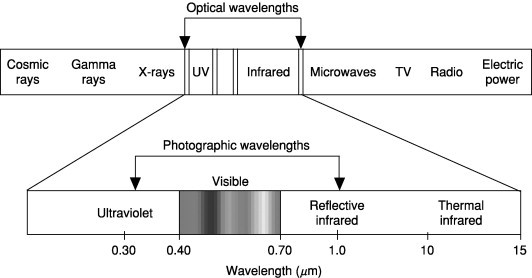
There are three different factors that can show the plants health. The visible green light is reflected the most because the chlorophyll absorbs the blue and red, so their reflectance is low. It is important to note that chlorophyll does not reflect green, since it only absorbs the other colours. The near-infrared can indicate a healthy plant, if its reflectance is high. This depends on the cell structure of the plant. The short-wave-infrared controls the water absorption, which means that it is another indice of the plant’s health (Campbell, 2011).
Therefore, remote sensing can be used widely in the field of plant ecology. Due to the growing awareness of how useful it can be regarding this area, the EU has even launched a programme called Copernicus, which offers access to over 12 Terabytes of images each day. Furthermore, other programmes make a lot of aerial photos available, which are easily accessible. This does not only include satellites, but also drones and small satellites. In addition to that, the enhancement of the technology also increases the speed of photo processing. Especially within plant health management, the usage of remote sensing can be of big importance. Due to certain algorithms, it is now possible to detect insect pests and certain diseases in images. It is possible to see that plant ecology topics, especially plant health management, profit from the advanced technology of remote sensing. It will make research in fields as well laboratories easier (Beck, 2019).
I have done some research and stumbled upon the tool of hyperspectral remote sensing, which has proven very useful in recent studies. The spectral reflectance signatures will be analysed, which can show the relationship between chemical attributes and electromagnetic radiation of each plant. Although it might appear as if remote sensing based on satellites seems to be simpler and less time-consuming, it can carry a lot of negative aspects. The researcher must figure out which spatial detail is required for each sampling. Especially the focus on individual plants would cause issues, since satellite images of this high spatial resolution are not freely available. Therefore, the suggested hyperspectral method would be more cost-efficient. In addition to that, satellite based remote sensing can cause further errors. In recent studies, healthy and unhealthy plants have been mislabelled or entirely disappeared from the image. This could cause the spreading of plant pests. Although the chosen method might be time consuming, it causes less expenses and no errors caused by technology (Beck, 2019).
Sources:
Beck, P., Martínez Sanchez, L., Di Leo, M., Chemin, Y., Caudullo, G., De la Fuente,B. and Zarco-Tejada, P.(2019). Remote Sensing in support of Plant Health Measures –Findings from the Canopy Health Monitoring (CanHeMon) project. Publications Office of the European Union
Campbell, J. B. and Wynne, R.H. (2011). Introduction to remote sensing. Fifth edition. London, New York: The Guilford Press.
 10573750