Before taking the remote sensing class, I knew nothing about remote sensing, only that is has to do with satellites and GIS.
Remote sensing can be considered as a process, which monitors the surface of the earth and its physical characteristics. For instance, measuring the reflected radiation from a certain distance can be of big use for researchers that want to find out certain information about the earth`s surface, which would not be visible with the bare eye. It can be used for mapping natural disasters, ocean floor and the changes of cities and landscapes over the years. (USGS)
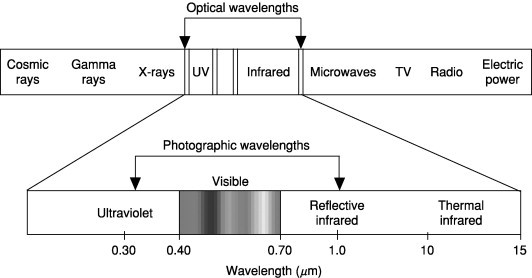
Landgrebe DA (2003) Signal Theory Methods in Multispectral Remote Sensing. New Jersey: John Wiley.)
This data can be collected by using sensors, which are either on satellites (satellite imaging) or aircrafts (aerial imaging). Those sensors can also be divided into active and passive ones. (National Ocean service) The collected data is electromagnet energy, as presented in Figure 1. There are different kinds of wavelengths, which are important for working with remote sensing. The important ones include visible, reflective infrared, thermal infrared as well as microwave regions. Microwave energy can be recorded on earth (Morris, 2005). A product, which is getting increasingly popular, is the Light Detection and Ranging (LiDAR), which enables to collect data from the ground or with help of airplanes. This device allows users to see tree-dimensional views of the surface of the earth. Since it is quite a newly introduced method, it is still relatively expensive. (Bettinger, 2017)
Sources:
https://www.usgs.gov/faqs/what-remote-sensing-and-what-it-used?qt-news_science_products=0#qt-news_science_products (accessed 02.10.2019)
https://oceanservice.noaa.gov/facts/remotesensing.html (accessed 02.10.2019)
Remote sensing | Organic matter D.K Morris, Steinhardt, G.C Encyclopedia of Soils in the Environment (2005)
Bettinger, P., Grebner, D. (2017) Geographic Information and Land Classification in Support of Forest planning. Forest Management and Planning. pp. 65-85
 10573750