A few months ago, I have attended a Geographical congress in Austria, where I took part in an interesting workshop. It dealt with using remote sensing and GIS to monitor glacial retreat. Back then, I never worked in those fields before, but I remembered our workshop`s topic in my remote sensing class.
Around 11% of the earth`s surface is covered by glaciers. The shrinking and melting of glaciers is a result of climate change, which is becoming a more important topic on daily basis. Since the amount and size of the ice is difficult to measure, remote sensing offers a great opportunity for getting precise information on it. Due to the high albedo and reflectance of glacier ice (50 – 80%) easy data identification. The changes can be identified through the satellites. When the ice melts, the water runs off in patterns and remote sensing can be of big help for figuring out the flow of the water. The mapping of this is very important for humans living around in the area as well as for possible avalanches (Aher, 2012).
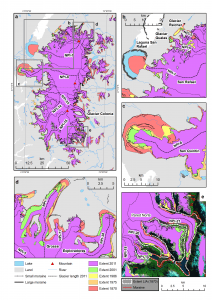
ASTER and Landsat images have proven as very useful for this, since they provide a regional view of the ice masses as well as a very fine resolution. Due to their long time series of photos, their images can be used for looking at changes throughout the years. Studies have shown the retreat of exact glaciers, for instance the Northern Patagonia Icefield, as visible in the image. Only in a short period of time, a lot of ice has melted off the glacier (Antarcticglaciers).
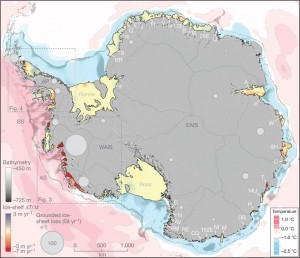
Yet, not only the retreat of glaciers can be analysed, but also the thinning of certain ice shelves. In the following image it is possible to see the change of thickness of Antarctica`s ice shelves.
It is possible to say, that remote sensing is the most useful tool for glaciologist or general glacial studies. Those pictures can also be of big help to raise awareness of the climate change and the current ice melting situation (Antarcticglaciers.org).
Sources:
Aher, S., Dalvf, S., (2012) Remote Sensing Technique for Monitoring the Glacier Retreating Process and Climatic Changes Study. Indian Streams Research Journal 2, 8.
(http://www.antarcticglaciers.org/glaciers-and-climate/glacier-recession/observing-glacier-change-space/) (accessed 16.10.2019)
Pritchard et al. (2012) Nature.
 10573750